Global Banks' Spillovers to Emerging Markets: Macro to Micro Transmission
Published 30 Nov 2025 · arxiv.org
Overview
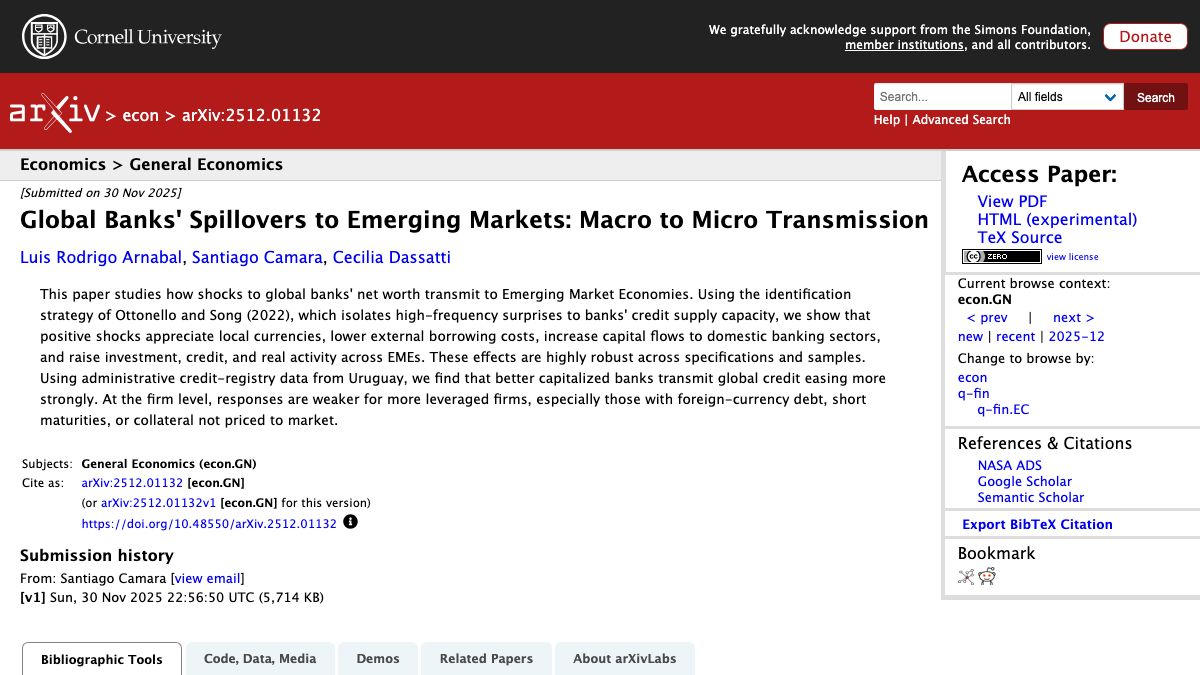
This paper investigates the transmission of global banks' net worth shocks to emerging market economies (EMEs). It uses high-frequency data to show how these shocks affect local currencies, borrowing costs, and capital flows.
Key Insights
- Currency Appreciation: Positive shocks to global banks' net worth lead to local currency appreciation.
- Evidence: Based on high-frequency surprises to banks' credit supply capacity.
- Verifiable: Yes
- Borrowing Costs and Capital Flows: These shocks lower external borrowing costs and increase capital flows to domestic banking sectors.
- Evidence: Administrative credit-registry data from Uruguay.
- Verifiable: Yes
- Investment and Credit Growth: There is an increase in investment, credit, and real activity across EMEs.
- Evidence: Robust across various specifications and samples.
- Verifiable: Yes
- Firm-Level Impact: More leveraged firms, especially those with foreign-currency debt, experience weaker responses.
- Evidence: Firm-level data analysis.
- Verifiable: Yes
Why It Matters
Understanding these spillovers is crucial for managing financial stability in EMEs, particularly in banking and corporate sectors.
Actionable Implications
- Monitor global banks' net worth changes to anticipate currency and capital flow impacts.
- Develop strategies to mitigate risks for highly leveraged firms with foreign-currency exposure.
- Enhance regulatory frameworks to manage spillover effects more effectively.
researcher global article banking financial-services cross-bfsi